

A MOV file won’t play when its codec is unsupported, the file is corrupted, or the media player or system is outdated. Fix it by converting the MOV file with MiniTool Video Converter, installing the HEVC codec, using another player, repairing the file, or updating Windows, drivers, or QuickTime.
What Is MOV File Format
The MOV file format is one of the most popular video file types used to store movies, TV shows, short videos, or home movies. Files with the MOV file extension are Apple QuickTime Movie files stored in QuickTime File Format (QTFF) container files.
MOV video files are the standard for Apple products. For example, Apple's iMovie video editing software uses MOV to export videos, and iPhone/iPad uses MOV to save video recordings from the default camera app.
Many devices and applications can open MOV files. A MOV file can be easily played with Windows Media Player and the Movies and TV app on a PC and QuickTime Player on a Mac. However, occasionally, a MOV file won’t play on your PC or Mac.
How to Fix MOV File Not Playing on Windows Media Player
- Convert the MOV File Format
- Install HEVE Codec
- Use Another Video Player
- repair broken MOV videos
- Restart Your PC
- Update the Media Player
- Run Video Playback Troubleshooter
- Update Display Drivers
- Check for Windows Updates
The common reasons for MOV file not playing include missing codecs, corrupted video files, temporary system glitches, etc. Try the following methods if your MOV file won’t play due to codec, file, or system issues.
Case 1: Incompatible MOV Codec Issue
Some users reported that they transferred some MOV files recorded by an iPhone to a laptop, but these MOV files can’t be played on Windows Media Player with the following error message.
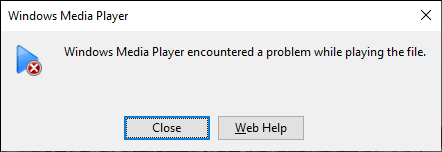
MOV is one of the video file formats supported by Windows Media Player, but iPhone video recordings cannot be opened on Windows. This is due to codec issues.
iPhone uses H.264 MOV file format to save video recordings from the default camera app. To use less storage space, the iPhone also allows you to save recordings in HEVC, also known as H.265, which offers better compression than H.264.
By default, Windows does not include the HEVC codec. Therefore, you cannot open MOV files encoded with HEVC through Windows Media Player. In this case, you have three options to fix MOV file not playing on Windows.
Way 1: Convert the MOV File Format
Fast steps:
- Install MiniTool Video Converter.
- Import the HEVC-encoded MOV file.
- Set the output format and video encoder.
- Set the save folder.
- Start conversion.
MiniTool Video Converter is a free video converter for Windows without watermarks. It supports various formats and lets you adjust the encoder, resolution, frame rate, and bitrate. It also supports batch conversion, video-to-audio conversion, and screen recording. Here's how to convert HEVC MOV to H.264 MP4 or MOV.
Here's how to use it to convert MOV files encoded with HEVC to H.264 MP4 or MOV files.
1. Install MiniTool Video Converter.
Download and install MiniTool Video Converter on your PC.
 MiniTool Video Converter
-
 Batch convert video/audio files among 1000+ formats.
 - Quickly compress videos for easy storage and transfer.
- Accurately extract subtitles from video/audio files.
- Effectively enhance video quality.

2. Import the HEVC-encoded MOV file.
After installation, open MiniTool Video Converter and click Add Files to upload your MOV video file.
3. Set the output format and video encoder.
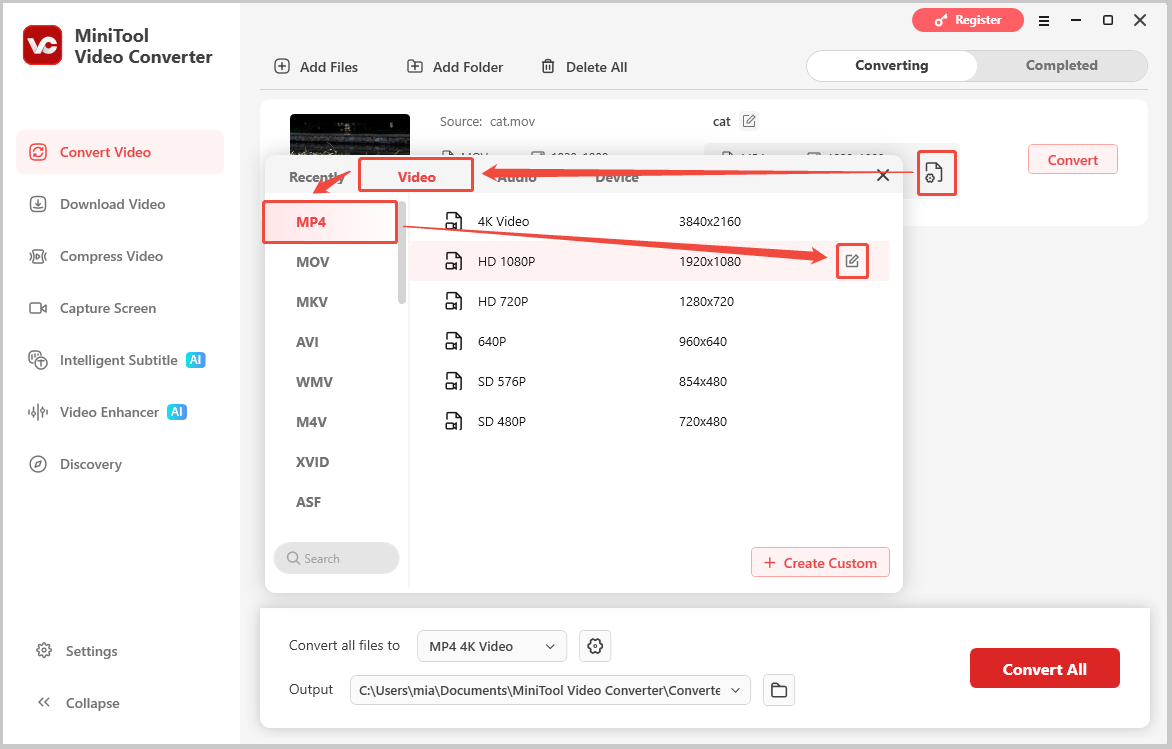
Click the gear icon to open the output format window. Go to the Video tab, choose MP4 or MOV, select the desired resolution profile, and click the edit icon next to the corresponding resolution profile to open Settings.
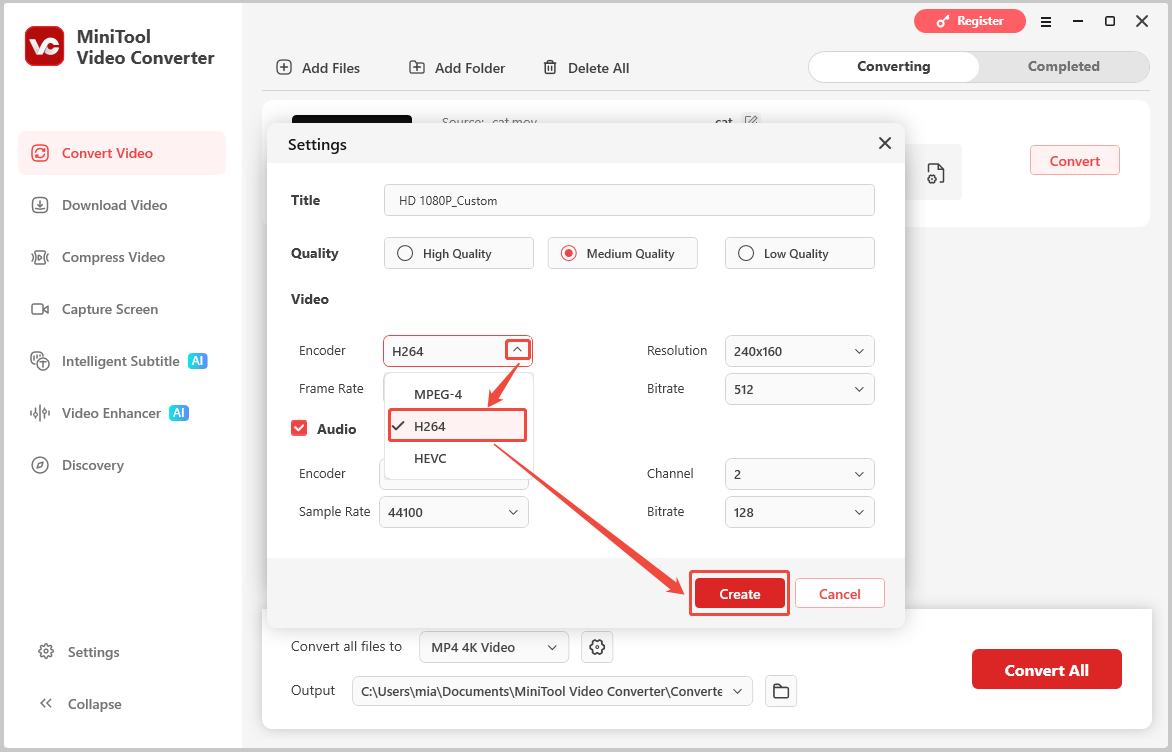
Expand the Encoder menu, then choose H264, and configure other parameters, including resolution, frame rate, bitrate, etc. Then, click Create.
After that, find and select the custom format from the format list. Then, you’ll return to the main user interface.
4. Set the save folder.
In the lower-left corner, click the Output menu and choose Browse to change the destination folder.
5. Start conversion.
Finally, click the Convert optionto start the conversion task.
Way 2: Install HEVE Codec
Windows does not have a built-in HEVC codec, but Microsoft offers paid HEVC video extensions in the Microsoft Store. You can purchase and install it on your computer to play HEVC videos on Windows 10/11 devices. This can also solve the problem of HEVC-encoded MOV files not playing on Windows.
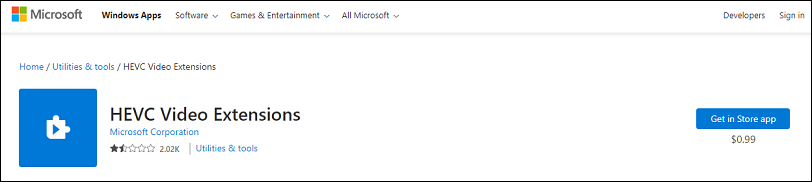
Alternatively, you can install Windows 10 Codec Pack or K-Lite Codec Pack on your PC to fix MOV playback issues related to other missing codecs.
Way 3: Use Another Video Player
If your MOV file won’t play with Windows Media Player, you can use another video player, and many of them support playing HEVC videos, such as
- VLC Media Player
- 5KPlayer
- DivX Player
- PotPlayer
- CyberLink PowerDVD

Case 2: Video Corruption
Fast steps:
- Open MiniTool Video Repair.
- Add the MOV file.
- Start repairing.
- Save the repaired file.
If your H.264 MOV file still won’t open on Windows, it may be corrupted. In this case, use a MOV video repair tool like MiniTool Video Repair to fix it.
MiniTool Video Repair is a free tool that repairs corrupt MOV, MP4, M4V, and F4V files, including videos from GoPro, Sony, Canon, and DJI drones. It supports batch repair, repaired video previews, and Advanced Repair for severely damaged videos.
Here’s how to repair broken MOV videos with MiniTool Video Repair.
1. Get MiniTool Video Repair.
Download and install MiniTool Video Repair on your PC. Then, launch this application to access its main interface.
MiniTool Video RepairClick to Download100%Clean & Safe
2. Add the MOV file.
Click the Add video(s) and start repairing button and upload your MOV file from your PC.

3. Start repairing.
Click the Repair button in the bottom-right corner and MiniTool Video Repair will immediately start repairing the video. Once done, click OK.
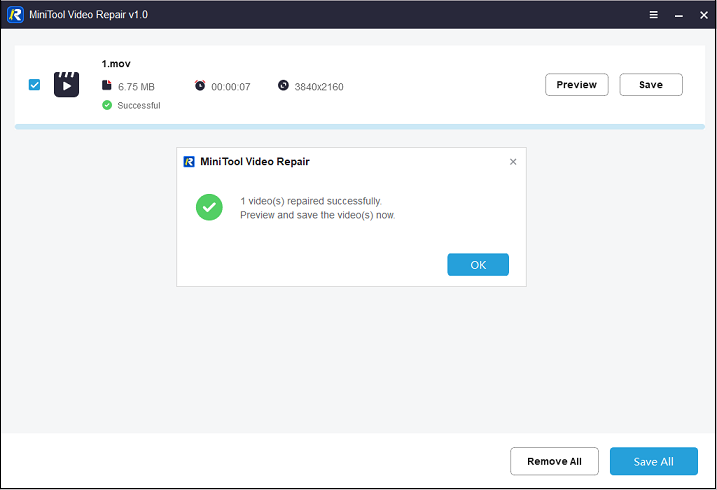
4. Save the repaired file.
Click Save and choose a directory to save the repaired MOV video on your PC.
![[5 Ways] How to Fix Adobe Media Encoder Not Working Issues?](https://images.minitool.com/videoconvert.minitool.com/images/uploads/2022/09/adobe-media-encoder-not-working-thumbnail.png)
Other Fixes for MOV File Not Playing on Windows
Apart from the above solutions, here are some other ways to fix MOV files not playing on Windows issue.
# Restart Your PC
When your MOV files are not playing, a simple fix is to exit the media player, restart it, and then try playing the video. If this doesn’t help, restart your PC.
# Update the Media Player
Whether you are using the default media player or a third-party application to play MOV files, make sure your media player is up to date for smooth video playback.
# Run Video Playback Troubleshooter
When you have problems playing videos, TV shows, or movies on your computer, run the video playback troubleshooter to find and fix the problem. Of course, you can do this when a MOV file won’t play on Windows.
On Windows 10:
Click Start > Settings > Update & Security > Troubleshoot > Additional troubleshooters. Select Video Playback and click Run the troubleshooter button.
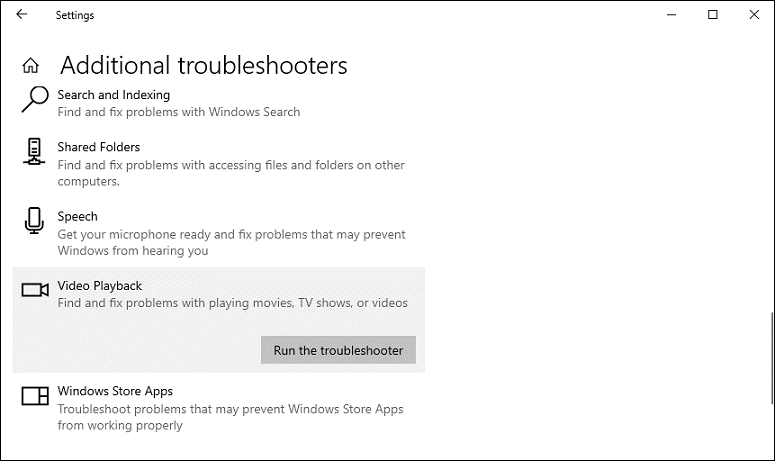
On Windows 11:
Click Start > Settings > System > Troubleshoot > Other troubleshooters. Click Video Playback and click the Run button.
# Update Display Drivers
Outdated graphics drivers can also prevent MOV videos from playing on Windows. To fix this issue, update the graphics drivers.
Press the Win + R keys, enter “devmgmt.msc” in the Run dialog box, and click OK to open Device Manager. Expand Display adapters, right-click on the target graphics device, click Update driver, and follow the on-screen prompts.
# Check for Windows Updates
Video playback issues may be caused by an outdated Windows operating system. Therefore, you can update Windows to fix MOV file not playing issue.

How to Fix MOV File Not Playing in QuickTime
Sometimes, QuickTime Player may show “The file isn’t compatible with QuickTime Player” when opening a MOV file. This section tells you the reason and fixes.
Why a MOV File Won’t Play in QuickTime on Mac
First, we need to rule out missing HEVC codec support. HEVC and HEIF are supported on macOS High Sierra and later and iOS 11 and later. This allows apps like QuickTime Player, Photos, and iMovie to view, edit, or copy HEVC videos and HEIF images. However, other missing or incompatible codecs may also prevent a MOV file from playing in QuickTime.
Other possible reasons include an outdated QuickTime Player or a damaged MOV file. Here are 4 ways to fix the MOV playback issue.
Way 1: Update QuickTime Player
Updating QuickTime Player to the latest version can help resolve issues that may prevent QuickTime from opening MOV files. On Mac, updating QuickTime Player is equivalent to updating macOS because the application is integrated with the operating system.
Way 2: Convert MOV to a Format Natively Supported by QuickTime Player
To fix MOV file not playing due to codec incompatibility, convert the MOV file to a format supported by QuickTime. The easiest way is to convert the video to a MOV file encoded using H.264/MPEG AVC or H.265/HEVC (since macOS 10.13) since QuickTime natively supports both codecs.
To do this, you can try the following video converters:
- Leawo Video Converter
- Any Video Converter
- WonderFox HD Video Converter Factory Pro
- WinX HD Video Converter Deluxe
- CloudConvert
- FreeConvert
- …
Way 3: Use Another Media Player
In addition to QuickTime, there are many alternatives you can try to play videos on your Mac. When QuickTime fails to open your MOV file, you can also use the following media players:
- VLC Media Player
- Elmedia Video Player
- Cisdem Video Player
- MPlayer X
- Total Video Player
- …
Way 4: Repair Corrupt MOV Files
If your MOV file is broken, you will not be able to open it using QuickTime Player or other video players. You have to fix it to play. To do this, you can try the following MOV file repair tools:
- Stellar Repair for Video
- EaseUS RepairVideo
- VLC Media Player
- Wondershare Repairit
- Fix.Video
- 4DDiG Video Repair
- …
![How to Fix QuickTime Not Recording Audio on Mac [Solved]](https://images.minitool.com/videoconvert.minitool.com/images/uploads/2022/08/quicktime-not-recording-audio-thumbnail.jpg)
Conclusion
When a MOV file won’t play, first check for codec incompatibility or file corruption. On Windows, convert HEVC MOV to H.264, install the HEVC codec, use another player, or repair the file. On Mac, update QuickTime, convert the MOV to a supported codec, use another player, or repair the corrupted video.
Finally, if you have any questions while using MiniTool products, you can contact via support@minitool.com for help.
User Comments :