

This article explains the similarities and differences between MP4 and WMV, including quality, file size, popularity, compatibility, advantages, and disadvantages. In addition, it shows how to convert WMV to MP4 using MiniTool Video Converter and MiniTool MovieMaker.
What Is MP4?
MP4 (MPEG-4 Part 14) is a popular multimedia container format for storing video, audio, and text. It supports online streaming and is widely popular on different platforms.
What Is WMV?
WMV (Windows Media Video) is a video compression format developed by Microsoft. It was originally designed for Internet streaming and is also used in formats like HD DVD and Blu-ray discs.
MP4 vs WMV: Similarities and Differences
This part focuses on WMV vs MP4, including similarities and differences.
MP4 vs WMV: Similarities
Although MP4 and WMV are different containers, they still have something in common.
- Both support high-quality video compression.
- Both offer good compression to save storage space.
- Both are widely used and compatible with their respective platforms.
MP4 vs WMV: Differences
| MP4 | WMV | |
| Quality | High | High |
| File Size | Small with modern codecs | Usually larger with older codecs |
| Popularity | Very popular | Popular on Windows |
| Compatibility | Excellent | Mainly Windows |
# MP4 vs WMV: Quality
Both MP4 and WMV can contain high-quality videos.
Many users think MP4 offers better quality than WMV. However, formats like MP4 and WMV are only containers used to store video and audio streams. The final video quality is determined by factors such as the encoder used, compression settings, bitrate, and the original source file.
# MP4 vs WMV: File Size
For the same quality, MP4 files encoded with H.264 or H.265 can be smaller than WMV files.
Theoretically, since an MP4 file compression level is lower than a WMV file, it should be larger than a WMV file for the same video quality. But this is only true if they both use the same level encoder. The fact is that WMV still uses the old family of codecs — WMV1, WMV2, and WMV3 — while MP4 can use more advanced codecs, such as H.264 and H.265.
With more advanced encoders, you can achieve high-quality but smaller videos.

# MP4 vs WMV: Popularity
MP4 is more widely used than WMV across websites, devices, and media platforms.
MP4 has become the standard video format for streaming, sharing, and playback because it is supported by almost all operating systems, browsers, social media platforms, and media players. In contrast, WMV is mainly used in Windows-based environments and is less common on mobile devices and online platforms today.
# MP4 vs WMV: Compatibility
MP4 has better compatibility than WMV.
MP4 is supported on almost any platform/device, from Apple to Android to Microsoft. WMV is primarily played on Windows systems. It is not supported on iOS devices and many Android devices unless you have a third-party WMV player.
# MP4 vs WMV: Pros
MP4:
- Supports online streaming with good quality.
- Compatible with most media players and devices.
- Supports advanced codecs like H.264.
- Can store video, audio, text, and graphics.
WMV:
- Small file size.
- Good for email sharing.
- Optimized for Windows devices.
# MP4 vs WMV: Cons
MP4:
- Lossy format.
- Harder to edit or update.
- May take more storage space.
WMV:
- Limited compatibility outside Windows.
- May experience playback or transmission delays.
There is no absolute winner between MP4 and WMV, as the choice depends on your needs and device compatibility. However, since MP4 offers broader compatibility than WMV, many users convert WMV to MP4 for easier playback and sharing across platforms.
How to Convert WMV to MP4
This part will show you how to convert WMV to MP4 with a video converter and a video editor.
Option 1. Use MiniTool Video Converter
MiniTool Video Converter is a free audio and video converter on Windows, allowing you to convert video to video, audio to audio, and video to audio. It’s 100% free, simple to use, and won’t add watermarks to the converted files. Besides, it can handle batch conversion.
Follow the guide below to learn how to convert WMV to MP4 with MiniTool Video Converter.
Fast Track:
- Install MiniTool Video Converter.
- Add the target WMV file.
- Choose output format.
- Select the destination folder.
- Start conversion.
- Check the converted file.
 MiniTool Video Converter
-
 Batch convert video/audio files among 1000+ formats.
 - Quickly compress videos for easy storage and transfer.
- Accurately extract subtitles from video/audio files.
- Effectively enhance video quality.

Step 1: Install MiniTool Video Converter.
Get the installer of MiniTool Video Converter, then install it on your computer.
Step 2: Add the target WMV file.
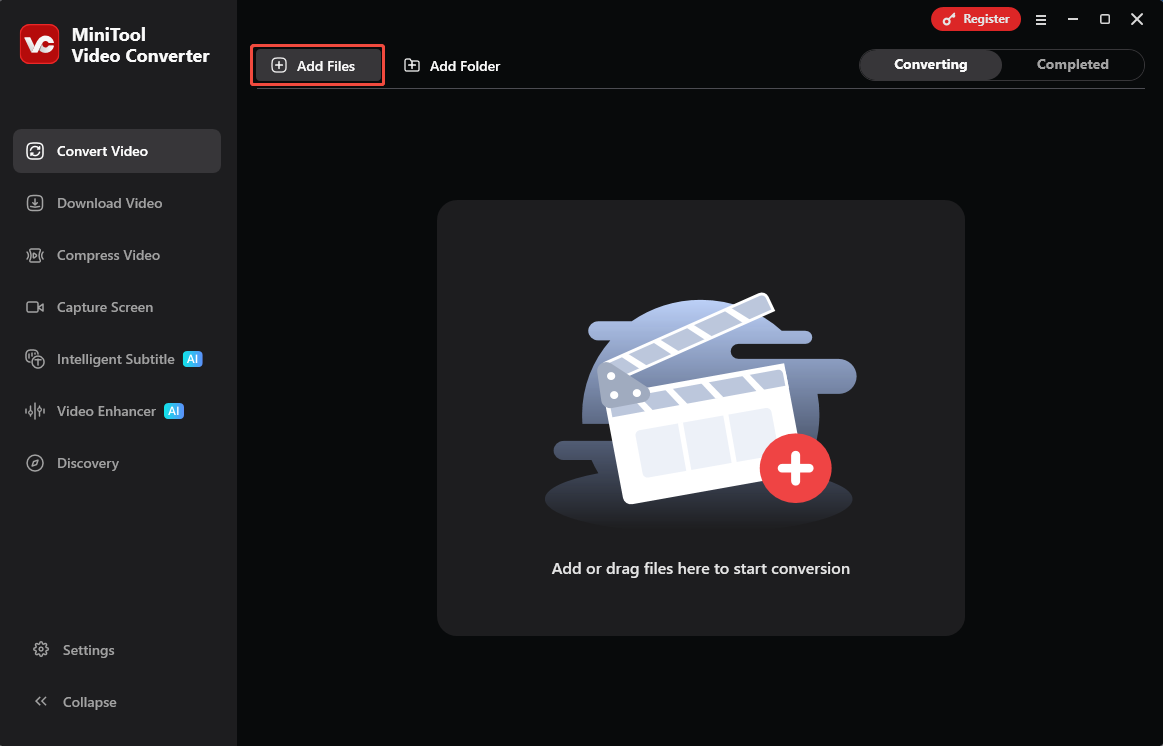
Launch MiniTool Video Converter and access its interface. Then click the Add Files option and upload the needed WAV files. Or just drag and drop the needed files to MiniTool Video Converter.
Step 3: Choose output format.
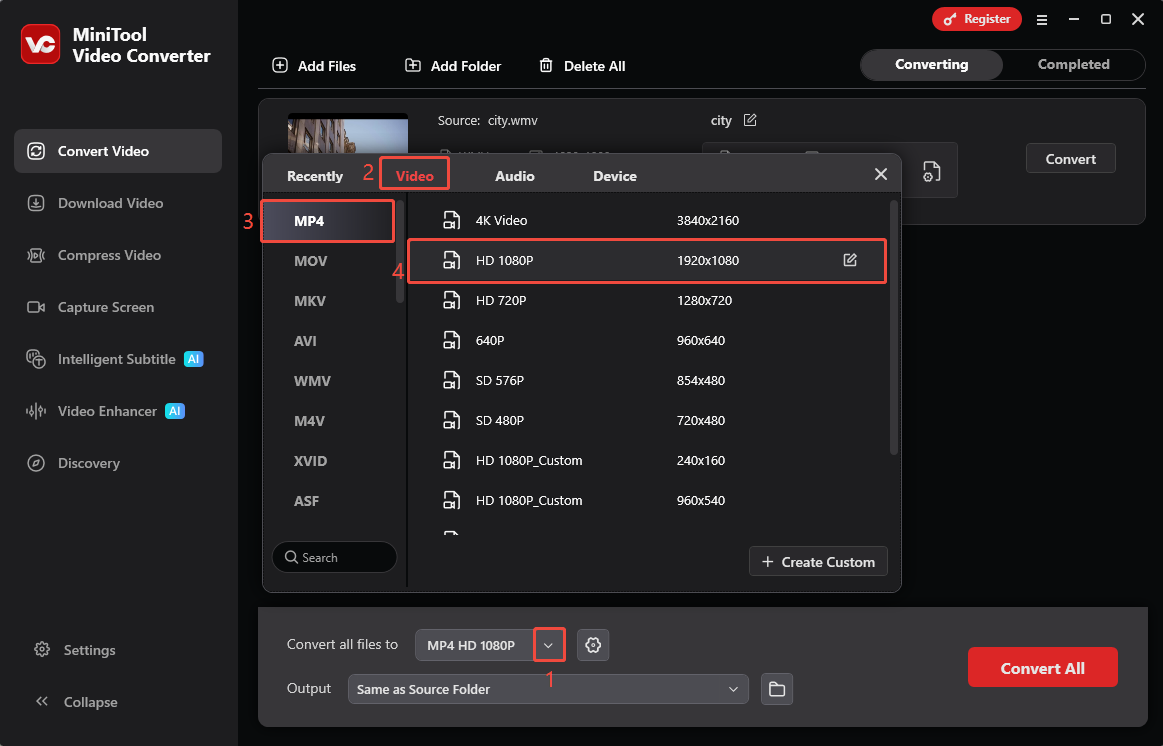
Click the box next to Convert all files to, then navigate to the Video tab, and select MP4 from the left list. Then choose the desired video quality.
Step 4: Select the destination folder.
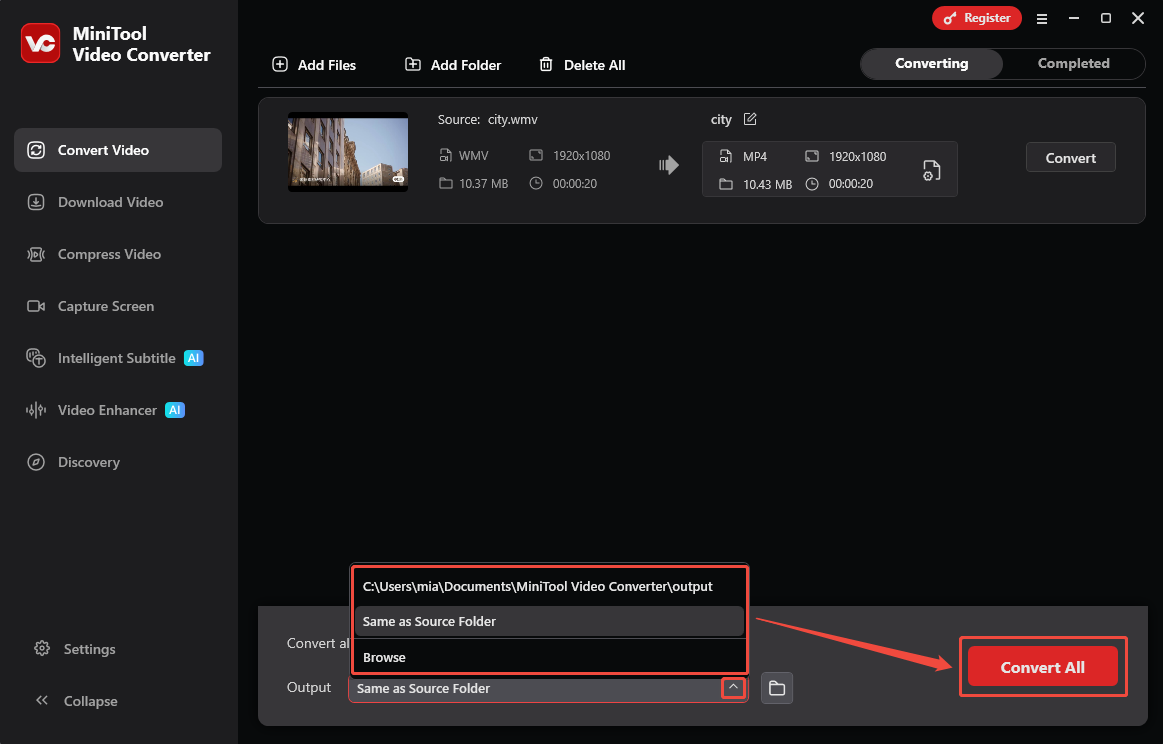
Click the inverted triangle symbol in the Output bar, select the Browse to browse for another destination folder, or click the Same as Source Folder option.
Step 5: Start conversion.
Click the Convert all button to start the conversion process.
Step 6: Check the converted file.
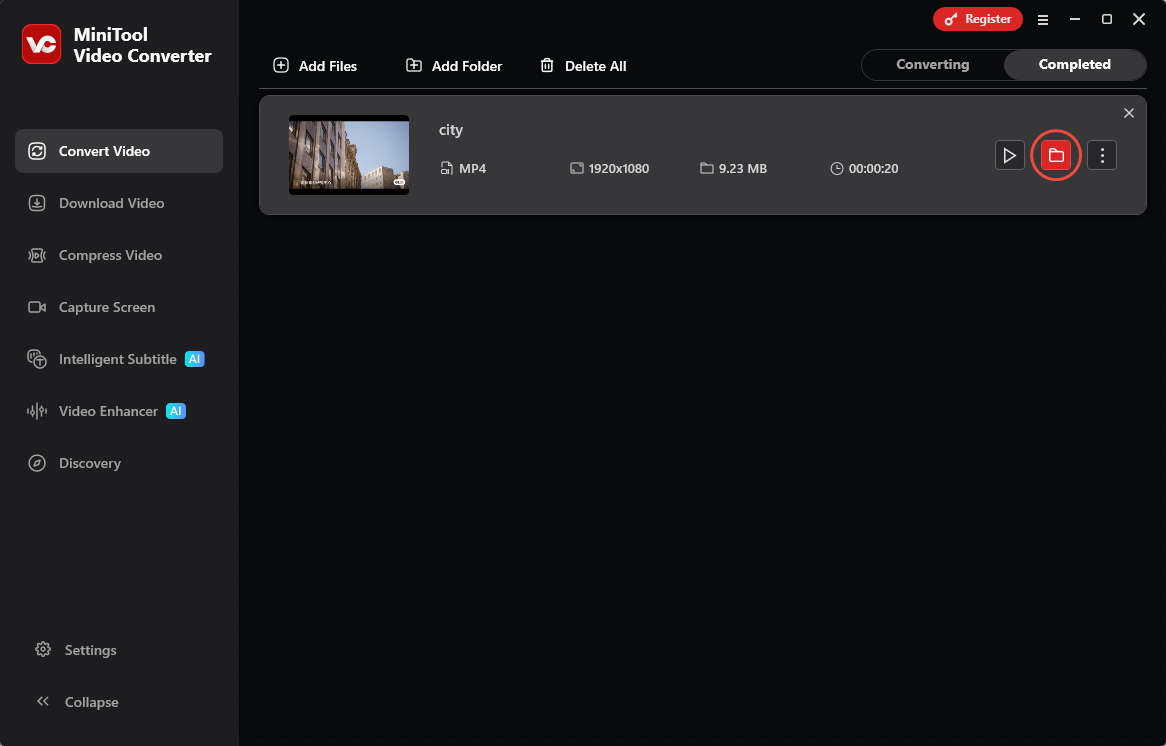
Once the conversion is finished, go to the Completed tab, click the folder icon to check the converted files.
With these steps, you can convert your WMV files to MP4 easily.
Option 2. Use MiniTool MovieMaker
MiniTool MovieMaker can convert formats like WMV to MP4, MP4 to WMV, MKV to MP4, etc. It also includes basic editing features such as trim, split, speed adjustment, effects, transitions, and text adding.
This guide will walk you through the steps for how to convert WMV to MP4.
Fast Track:
- Install MiniTool MovieMaker.
- Import the WMV file.
- Edit the video if necessary.
- Export the video in MP4.
Step 1: Download and install MiniTool MovieMaker.
Download MiniTool MovieMaker and install it on your computer.
MiniTool MovieMakerClick to Download100%Clean & Safe
Step 2: Import the WMV file.
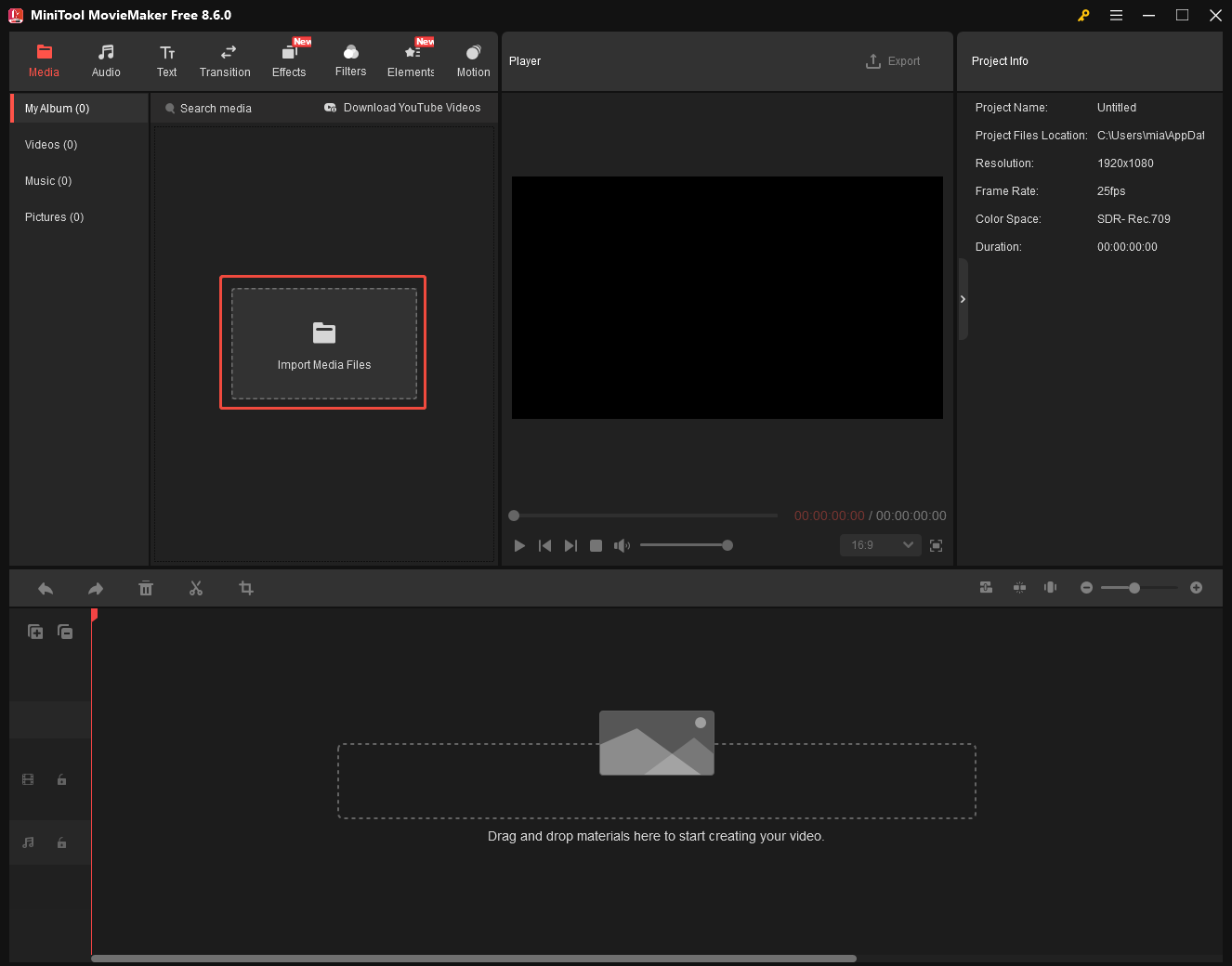
Double-click on the software icon to launch it. Then shut down the pop-up window to get the main interface. Click Import Media Files to open the WMV file you want to convert.
Step 3: Edit the video if necessary.
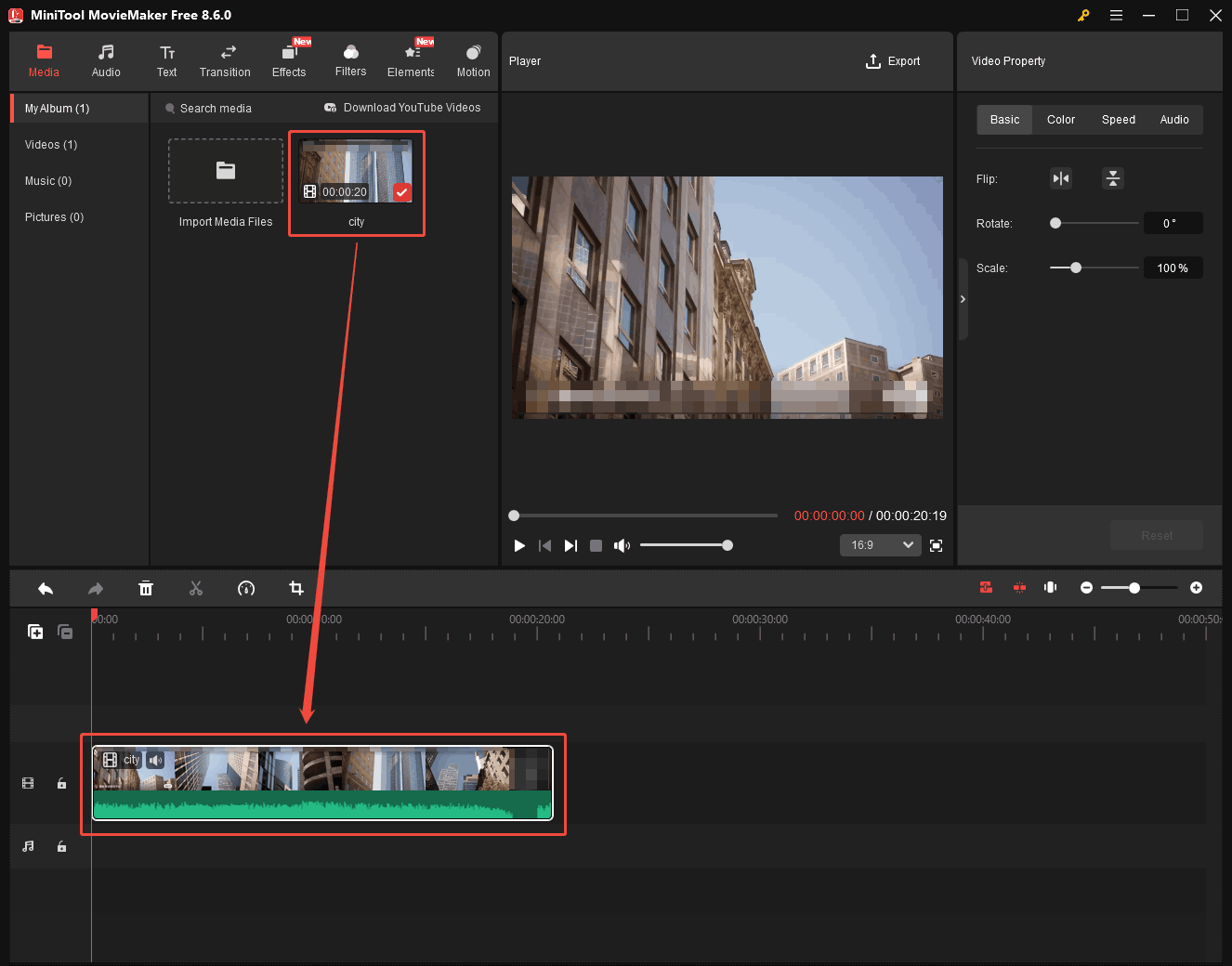
Drag and drop the WMV file to the timeline. Before exporting the WMV video file in MP4 format, you can edit the WMV file as needed.
Step 4: Export the video in MP4.
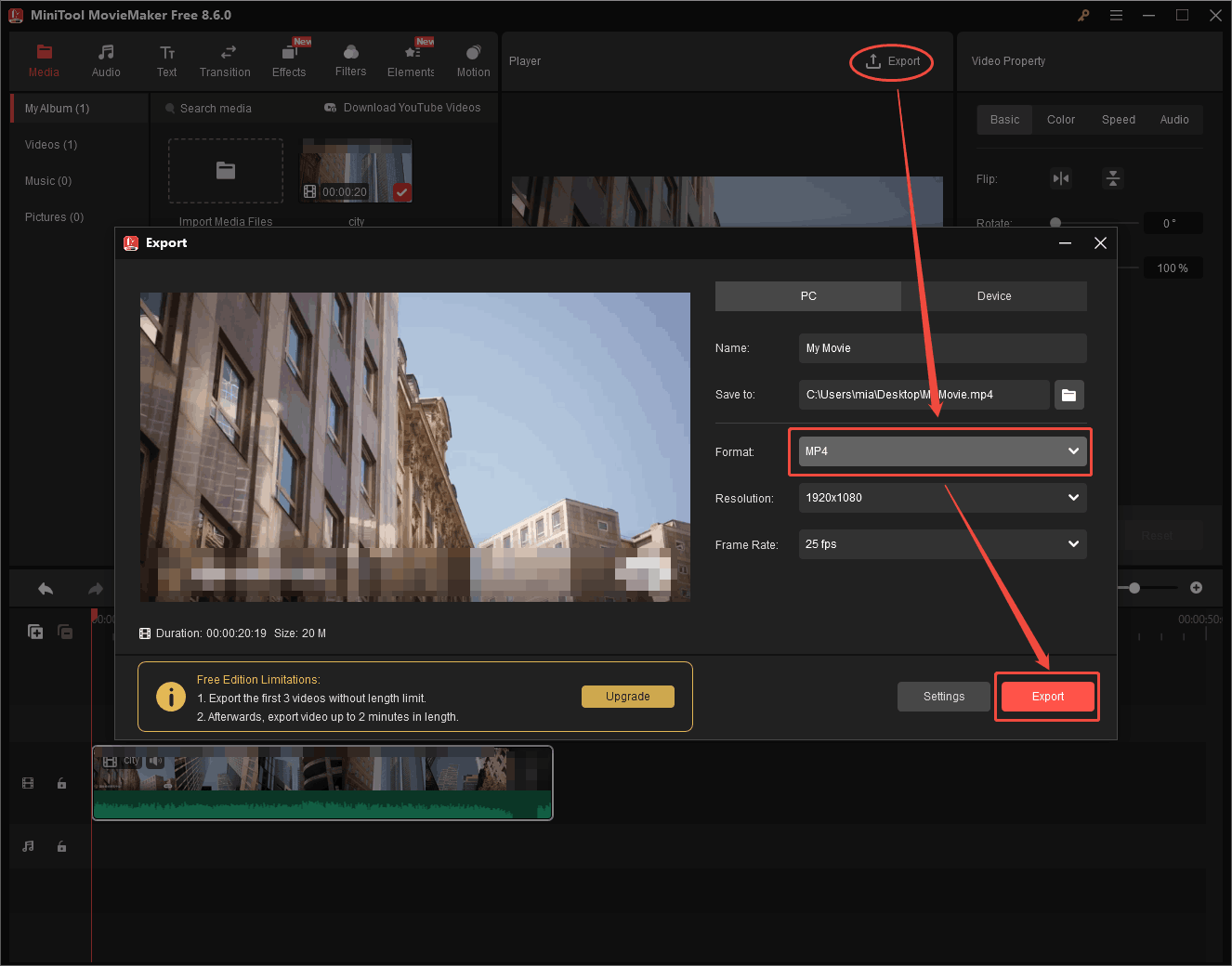
After editing the WMV video, tap on Export in the menu bar. Then, you can select the MP4 option as the output format. Finally, click Export to save the video as MP4.

Bottom Line
MP4 and WMV both support high-quality video compression, but MP4 offers better compatibility and broader platform support. If you need easier playback and sharing across devices, converting WMV to MP4 is a practical choice. MiniTool Video Converter and MiniTool MovieMaker can help you.
If you have any problem with MiniTool software, please feel free to contact us via the email support@minitool.com.
User Comments :