

This article explains how to convert iTunes to MP3 using three methods. In iTunes, users adjust import settings, select songs, and create MP3 versions. With MiniTool Video Converter, users import M4A files, choose MP3 output, and start conversion. With NoteBurner, users add music, set MP3 format, and convert files.
iTunes, developed by Apple.inc, allows users to download, play, organize and manage music/video files in their iTunes music library. It is not only compatible with Mac OS and Microsoft Windows but also functions well on mobile devices like iPhone, iPad and iPod touch.
Why Convert iTunes to MP3
- Create an MP3 CD using the iTunes playlist.
- Store your songs on USB flash drive so you can listen to the music on the car.
- Listen to music in other media players.
- Convert high-quality lossless files to other formats to release space.
How to Convert iTunes to MP3 with iTunes
Mostly, the file formats that are playable in iTunes Library include AIFF, WAV, AAC, and M4A. However, there is an option that is built into the iTunes library, which supports you to convert your iTunes music into an MP3 format.
Fast Steps:
- Open iTunes.
- Go to preferences.
- Choose MP3 as the output format.
- Save the conversion settings.
- Select the songs you want to convert.
- Convert the selected songs into MP3 files.
1. Open iTunes to access your media library.
First of all, you have to open your iTunes on your Mac. To do this, double-click on the iTunes icon that is present in your system.
2. Go to preferences.
Choose the Preferences option, which is under iTunes from your menu bar.
3. Choose MP3 as the output format.
Now, you have to select the General tab. Once this is down, you will find the Import Settings option will be present on the lower side of the window.
4. Save the conversion settings.
Now, there is an option to choose which type of encoding format that you would like to convert your files to. Choose MP3 Encoder to convert iTunes files into an MP3 format. The encoding option that can be found by clicking on the menu that is right next to Import Using.
5. Select the songs you want to convert.
To save your settings, click OK. Now, select the songs that you want to convert into the MP3 format.
6. Convert the selected songs into MP3 files.
In the File section, you will find the Convert option. Once you’re down with that, you will now select Create MP3 Version. All your converted songs will now be playable and can be seen in your library. If you're using the older version of iTunes, click Create new version.
How to Convert iTunes to MP3 with MiniTool Video Converter
MiniTool Video Converter is a versatile tool that supports many audio formats, including M4A, MP3, AAC, and more. You can use it to convert iTunes (M4A files) to MP3 for better compatibility and easier use across different devices and platforms. Here’s how.
Fast Steps:
- Open MiniTool Video Converter.
- Import the iTunes file (M4A file).
- Set save location.
- Choose output format.
- Start conversion.
 MiniTool Video Converter
-
 Batch convert video/audio files among 1000+ formats.
 - Quickly compress videos for easy storage and transfer.
- Accurately extract subtitles from video/audio files.
- Effectively enhance video quality.

1. Open MiniTool Video Converter.
Download and install this video conversion software on your Windows PC. Then, launch it.
2. Import the iTunes file (M4A file).
Under the default Convert Video tab, choose Add Files to import the target iTunes file.
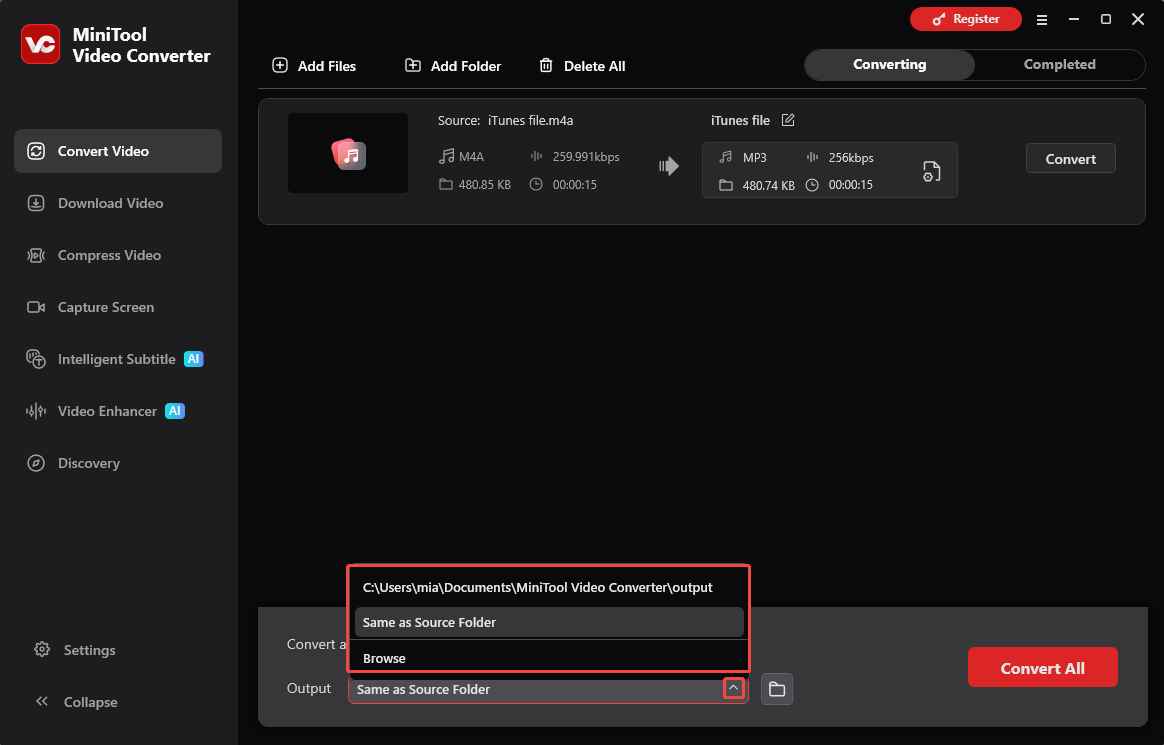
3. Set save location.
Expand the Output menu and choose the save destination.
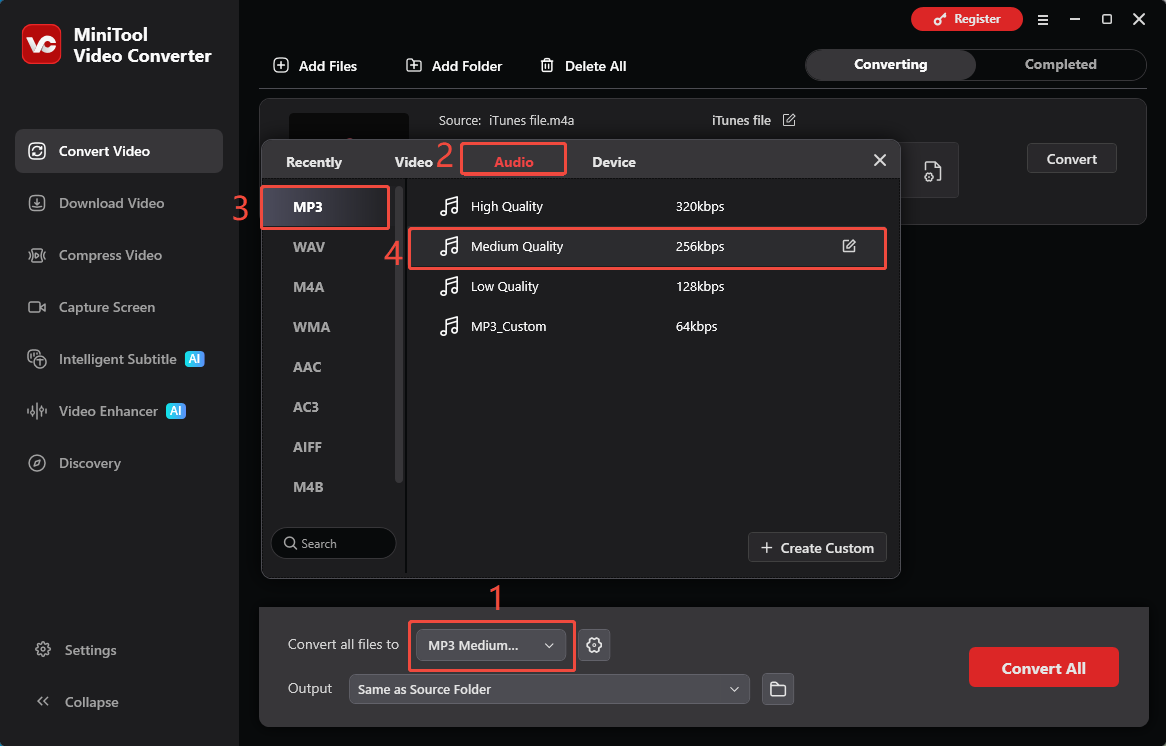
4. Choose output format.
Expand the Convert all files to option, select the Audio tab, click MP3 in the left column, and choose the audio quality.
5. Start conversion.
Click the Convert option to convert the M4A file to MP3.
The converted file will be saved in the folder you selected. After the conversion is complete, click the folder icon under the Completed tab to locate your MP3 file.
How to Convert iTunes to MP3 with NoteBurner
NoteBurner is a reliable Apple Music Converter, which is able to record iTunes audio files downloaded from iTunes and convert them to various common audio formats like MP3, AAC, FLAC, or WAV format.
Fast Steps:
- Open NoteBurner.
- Add music files.
- Set MP3 output.
- Convert and access files.
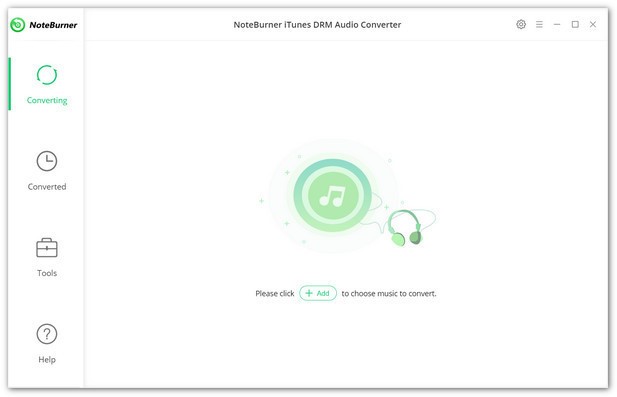
1. Open NoteBurner.
Launch this iTunes audio converter on your Mac.
2. Add music files.
Click the + button and then you will see a pop-up window that will show you all the iTunes folders. Add the music files as you want.
3. Set MP3 output.
Click the grey gear icon on the program interface to set the output path and choose MP3 as the output format.
4. Convert and access files.
When you finish customization, click the Convert button to start conversion. After conversion, you can click the History button to find the converted audio files.
After conversion, you can select a professional MP3 cutter to trim the MP3 file and then make a ringtone for your device.
Bottom Line
To convert iTunes to MP3, use iTunes or tools like MiniTool Video Converter and NoteBurner. Simply import the files, select MP3 as the output format, and convert them for better compatibility.
If you have any questions or suggestions about it, please send an email to support@minitool.com.
User Comments :