

This post explains how to upscale video to 1080p using a video enhancer: MiniTool Video Converter. It uses AI to analyze and fill in missing pixel details, genuinely improving clarity rather than simply enlarging the image.
AI upscaling isn’t simply about enlarging a video to a larger screen. It refers to using advanced AI (Artificial Intelligence) technology to upscale low-resolution video to a higher resolution. Without upscaling, a low-resolution video can’t fill a large screen, resulting in a blurry image and blackouts around the screen edges.
1080p resolution, also known as FHD, refers to a video where each frame displays 1920 pixels horizontally and 1080 pixels vertically. It can display rich video details. The 1080p standard is widely used, including in television broadcasting, smartphones, Blu-ray discs, and online streaming platforms, such as YouTube and Netflix.
How to Upscale Video to 1080P
Fast Track Steps:
- Download and install MiniTool Video Converter
- Import your low-resolution video.
- Set an enhancement level
- Preview the enhanced video.
- Start enhancement.
MiniTool Video Converter is an all-in-one media file processing tool. It also includes an AI-powered video enhancer to improve video quality. Why did I choose the software as my first choice? Here are the main reasons:
- Unlike traditional stretching, which only amplifies existing pixels, it uses AI to upscale videos by analysing frames and filling in missing pixels, generating sharper videos.
- The video upscaler is free, has no watermarks, and has no file size limits.
- Increases resolution to original, 2X, or 4X, up to 4K resolution. Even when the resolution stays the same, AI enhancement can dramatically improve the video quality.
- Supports side-by-side preview to compare videos before and after enhancement at key frames.
- Supports enhancing videos of different file formats.
- Includes a dedicated anime enhancer mode to optimize anime or cartoon videos.
How to upscale a low-resolution video to 1080p? Follow me:
1: Download and Install
Click the button below to download and install the AI video enhancer on your PC.
 MiniTool Video Converter
-
 Batch convert video/audio files among 1000+ formats.
 - Quickly compress videos for easy storage and transfer.
- Accurately extract subtitles from video/audio files.
- Effectively enhance video quality.
2: Import a Low-Resolution Video
Launch the software and switch to the Video Enhancer tab on the left sidebar. From there, click the Add Video option to import my target footage.
3: Upscale Video to 1080P
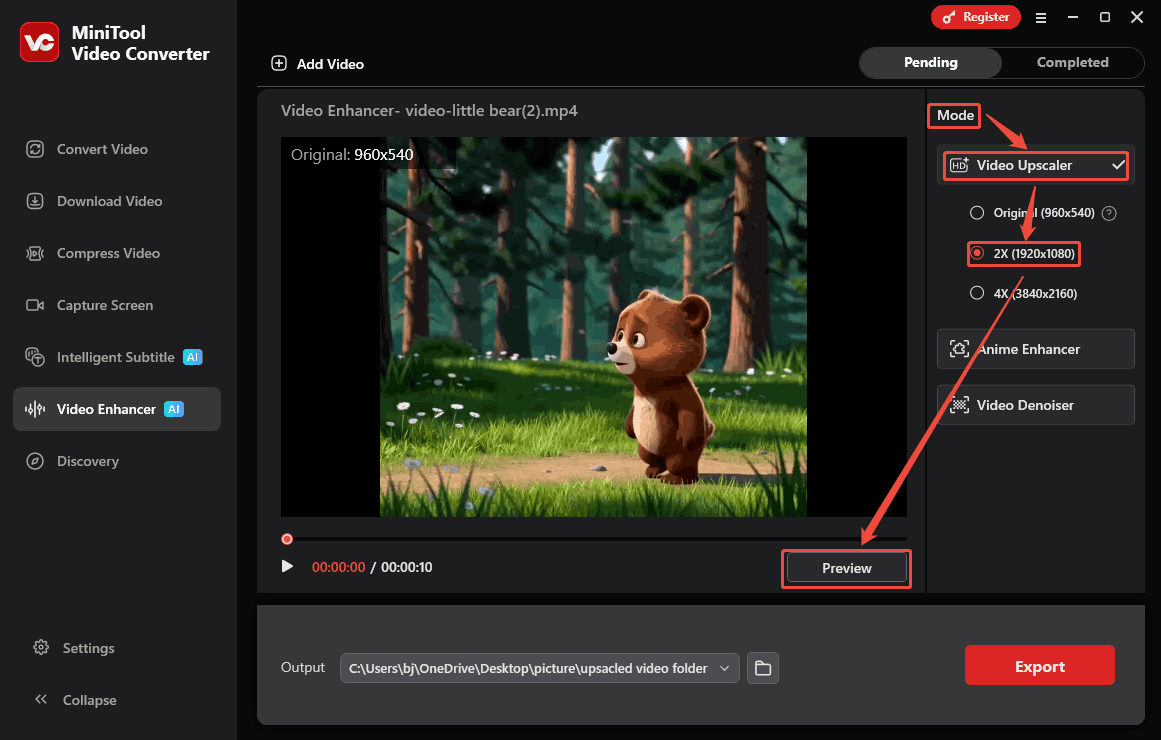
After importing the video, go to the Mode section on the right and expand the Video Upscaler option. Here, choose 2X or 4X based on the original resolution. My video resolution is 960x540, so I select 2X. Then, click the Preview button to preview the upscaled video effect. In the preview interface, I can view the before-and-after video effects side by side at key frames.
4: Export the Upscaled Video
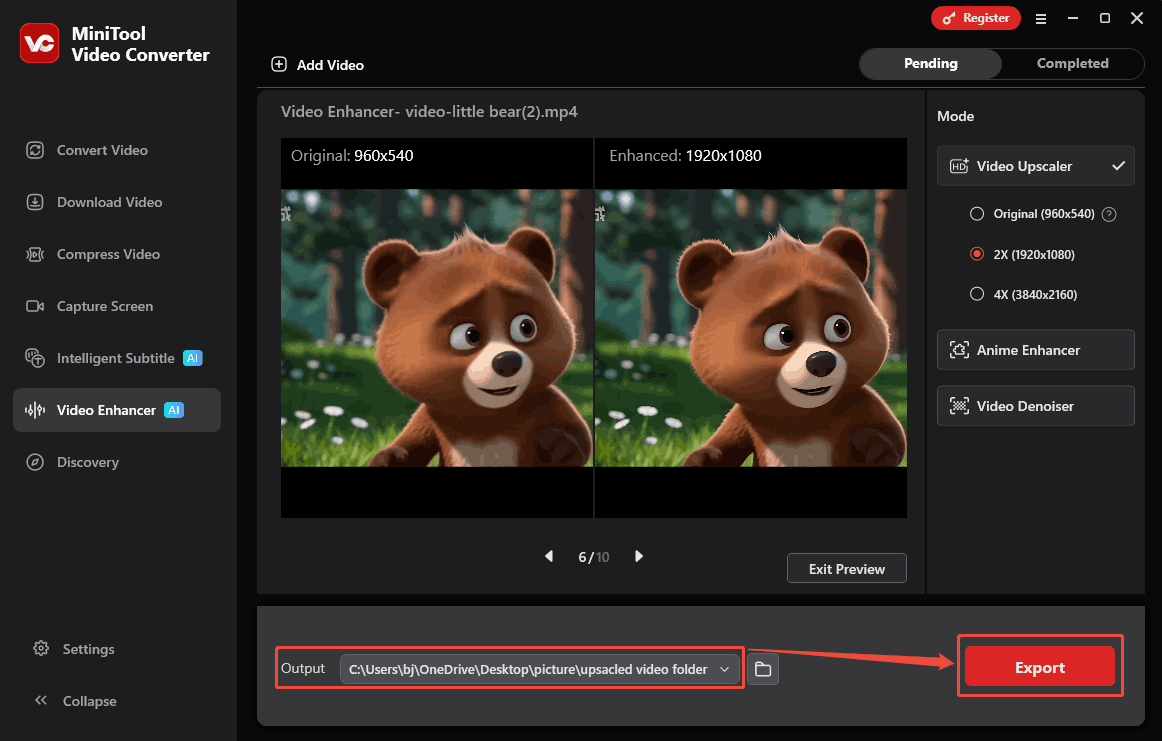
After that, expand the Output option and select a proper path for the exported video. Then, click the Export button to start exporting the video.
5: Check and Locate the Exported Video
Once the video is upscaled, it will appear in the Completed tab. Click on the Play icon to check it. Or I can click the Folder icon to locate the exported video on my computer.

Why Upscale Video to 1080P
The primary purpose of upscaling videos to 1080p is to improve video quality by increasing resolution and to make the video compatible with more modern high-resolution devices, thereby enhancing the visual experience.
Many modern devices support 1080p or higher resolutions. When importing low-resolution videos into these high-end devices, the video is enlarged frame by frame to fit the device’s screen. However, this enlarged video becomes blurry, affecting viewing. Using AI technology to add pixels to the video results in a sharper image. This both enlarges the image and improves video quality.
Other Target Resolutions for Upscaling
In addition to upscaling videos to 1080p, 2K, 4K, and 8K are also target resolutions for video upscaling. Below is a brief overview of the uses of these resolutions.
2K (2560x1440p): 2K is a common resolution standard for some smartphones and computer monitors. Compared to 1080p, it significantly improves the clarity of videos and device screens.
4K (3840x2160): 4K is the primary resolution standard used in modern smart large-screen TVs and online streaming media. Its sufficient number of pixels provides rich detail, enhancing the video viewing experience on large-screen devices.
8K (7680x4320p): 8K is primarily the top choice for future technological exploration and the pursuit of professional-grade image enhancement technology. It is mainly used in high-precision fields such as medical, aerospace, and defense to display as much detail as possible in the image.
Bottom Line
With the right video upscaler like MiniTool Video Converter, it's easy to upscale video to 1080p for enhanced quality and a better viewing experience. You can also upscale videos to 2K, 4K, and even 8K with a professional upscaler.
If you have problems while using MiniTool Video Converter, contact the support team at support@minitool.com for help.
People Also Ask
1. Open the software and select the Compress Video tab on the left sidebar.
2. Click Add Files at the top of the screen to import the target video.
3. Click the Settings icon and set the compression level.
4. Click Advanced Settings and set the resolution to 1920x1080.
5. Select the video encoder and frame rate.
6. Save the changes and click Compress.
About The Author

Position: Columnist
Cora is a tech writer specializing in digital media workflows, with over six years of hands-on experience in video post-production, media transcoding, and screen capture. Her writing is always clear and practical. Cora also produces in-depth software reviews for users across skill levels to help them find the right tool and enjoy video editing.
User Comments :